Turn Your History Book Idea Into a Structured Writing Project
ChronicleCraft AI provides editable Markdown frameworks and guided prompting protocols for book planning, research organization, chapter outlining, and a disciplined drafting workflow with a compatible AI assistant. You maintain full responsibility for archival sources, editorial decisions, and historical accuracy.
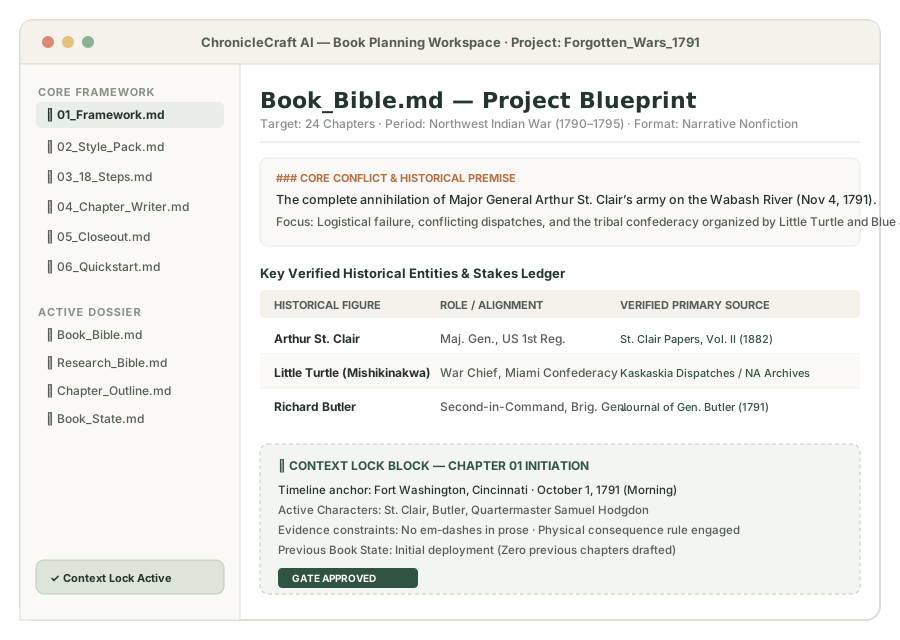




From a Raw Historical Topic to a Finished Manuscript
Writing serious narrative nonfiction requires moving through distinct phases of structure and verification. Here is what ChronicleCraft AI helps you build at each milestone.
01. Define Your Book’s Strategic Core
Transform a sprawling historical era into a tight, compelling commercial book project with a clear thesis, defined chronological boundaries, and an explicit reader profile.
Book_Bible.md — Master book thesis, dramatic stakes, target page length, and narrator voice guidelines.
02. Organize Sources & Canonical Entities
Prevent AI context collapse by cataloging primary dispatches, historical diaries, and Native testimonies alongside an immutable directory of commanders, forts, and terrain.
Research_Bible.md & People_Places_Entities.md — Source evidence ledger with discrepancy flags and entity registry.
03. Draft With Context-Lock Continuity
Draft chapter by chapter without losing track of previous injuries, seasonal weather, military ranks, or depleted ammunition stores.
Chapter_Manuscripts/ & Book_State.md — Verified chapter drafts formatted in Markdown with persistent state tracking.
How the Workflow Operates: Step-by-Step
For each stage of your book, ChronicleCraft AI gives you a clear starting input, an exact guided procedure, and a tangible Markdown output document.
STAGE 1: PLAN (Project Scope & Thesis)
Raw Idea & Topic Interest
A historical conflict, forgotten campaign, biography, or maritime disaster that you want to research and write about.
Review Narrative Framework
Apply 01_Narrative_History_Framework.md and calibrate prose voice rules with 02_Narrative_History_Style_Pack.md.
Foundational Project Thesis
A locked book concept, narrative point of view, target word count, and central historical argument ready for structuring.
STAGE 2: ORGANIZE (18-Step Planning Architecture)
Your Thesis & Known Primary Sources
Key archives, letters, dispatches, battle logs, and secondary histories you intend to reference.
Execute 18-Step Setup Prompt
Run 03_Setup_Prompt_18_Steps.md sequentially in your AI assistant to generate your full project dossier.
The 4 Core Project Dossiers
Book_Bible.md, Research_Bible.md (source ledger), People_Places_Entities.md, and Chapter_Outline.md.
STAGE 3: DRAFT & REVIEW (Context Lock Writing)
Chapter Beat & Active Book State
Chapter 1 scene outline and the Initial_Book_State.md tracking army condition, location, and date.
Draft With Context Lock Prompt
Use 04_Context_Lock_And_Chapter_Writer.md to draft scene by scene while enforcing factual boundaries and tone.
Finished Chapter & Updated State
A polished literary Markdown draft with source citations, plus an updated Book_State.md ready for Chapter 2.
STAGE 4: CLOSE OUT (Notes & Bibliography)
Completed Chapter Drafts
All drafted chapters with in-text citation markers and primary source references.
Run Back-Matter Engine
Execute 05_Book_Closeout_And_Bibliography.md to cross-check sources, format endnotes, and audit entity consistency.
Standardized Back-Matter
Complete endnotes, verified primary/secondary bibliography lists, and publishing-ready front/back matter in clean Markdown.
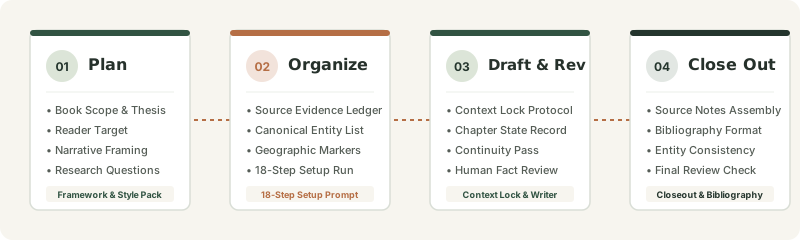
Examine the Real Output of the Planning Engine
These examples are taken directly from acceptance test runs on our 1791 St. Clair Wabash campaign case study. They demonstrate how the 18-step setup prompt structures complex history into organized, referenceable files.
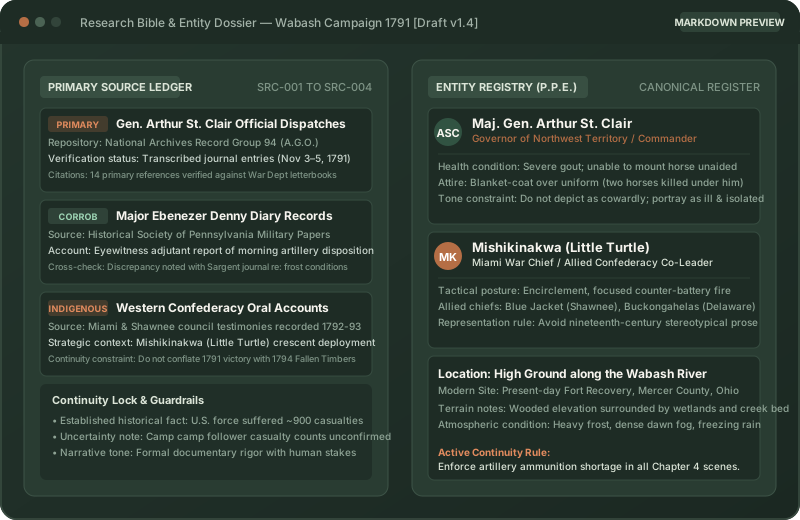
The Six Verified Markdown Resources
Every resource in the core ChronicleCraft AI system is delivered as an editable, portable Markdown document ready to paste into your preferred AI workspace or desktop editor.
Narrative History Framework
Sets up foundational narrative nonfiction rules: thesis statement structuring, reader positioning, balancing human drama against documentary evidence, and establishing clear temporal boundaries.
Narrative History Style Pack
Provides editorial guidelines for pacing, prose rhythm, descriptive atmosphere, period-accurate dialogue conventions, handling quoted archival material, and avoiding sensationalist or modern idioms.
18-Step Setup Prompt
An exhaustive sequential prompt that guides your AI assistant to generate your project’s complete planning architecture: Book Bible, Research Bible, Entity Tracker, and Chapter-by-Chapter Outline.
Context Lock & Chapter Writer
The core drafting engine. Enforces state continuity, character locations, chronological pacing, source attribution reminders, and scene transitions across individual chapter drafting sessions.
Book Closeout & Bibliography
Standardizes back-matter generation: organizing chapter citations, building primary/secondary source bibliographies, reconciling naming variations, and conducting final structural audits.
Customer Quickstart Guide
Step-by-step onboarding documentation explaining folder organization, file naming conventions, recommended local Markdown editors, and best practices for prompting AI assistants.
Verified Package Inventory
These 6 Markdown files constitute the complete core deliverable verified in the distribution archive. No undocumented bonuses or phantom files.
Why Use a Structured Workflow?
Standard AI assistants are trained to give quick, generalized answers. When tasked with writing multi-chapter narrative history, unstructured prompting quickly reveals fundamental limitations. Here is how structured planning creates an organized foundation.
| Historical Writing Task | Unstructured AI Prompting | ChronicleCraft AI Guided Workflow |
|---|---|---|
| Long-Form Continuity | ✕ Models naturally lose context across long chats, frequently forgetting earlier chapter dates, character locations, and established facts. | ✓ Initial Book State & Continuity Tracker passes forward key variables (weather, unit casualties, time) into each chapter session. |
| Narrative Style & Cadence | ✕ Generative AI naturally defaults to bland encyclopedic summaries, contemporary idioms, and repetitive phrasing. | ✓ Narrative History Style Pack provides explicit editorial constraints on sentence rhythm, sensory detail, and period quotation conventions. |
| Primary Source Records | ✕ Language models can generate plausible-sounding but fictitious sources, non-existent books, and fabricated quotes. | ✓ Evidence Ledger Framework structures sources into distinct IDs (SRC-001+) and prompts the author to record historical discrepancies explicitly. |
| Historical Nomenclature | ✕ Names, ranks, and historical place names often drift or change spellings unpredictably across chapters. | ✓ People, Places & Entities Register maintains canonical naming rules so historical figures are represented consistently. |
| Back-Matter Preparation | ✕ Compiling citations at the end of writing often leads to missing notes, mismatched references, and disorderly bibliographies. | ✓ Book Closeout Engine guides the compilation of chapter endnotes and primary/secondary source bibliographies organized alongside drafting. |
Compatible With Any Modern AI Assistant
Because ChronicleCraft AI is pure, portable Markdown, it operates smoothly across all major AI interfaces and desktop editors.
Anthropic Claude
Exceptional for natural literary cadence, sophisticated pacing, historical nuance, and rich character interiority (Claude 3.5 Sonnet / Opus).
OpenAI ChatGPT
Ideal for rapid 18-step setup execution, generating complex entity tables, and cross-referencing timeline dates (GPT-4o / Canvas).
Google Gemini
Outstanding for massive context analysis—feed full primary source PDFs, letters, and War Department records directly into Gemini 1.5 Pro.
Obsidian & VS Code
Store your Book Bibles and chapter drafts locally in plain text Markdown. Zero vendor lock-in, zero lost manuscripts, complete privacy.
Is ChronicleCraft AI Right for Your Project?
This system was engineered for authors who understand that historical writing requires meticulous structure, patient source tracking, and active editorial involvement.
✓ Who Will Benefit Most
-
✓
Independent Nonfiction Authors: Writers planning narrative history books who need a repeatable, disciplined system to manage hundreds of facts, dates, and historical figures.
-
✓
Historians & Researchers: Subject-matter experts who want to translate deep archival research into engaging, readable narrative chapters without sacrificing precision.
-
✓
Structured AI Practitioners: Authors who already use Claude, ChatGPT, or local LLMs and want structured prompts that minimize hallucinations and enforce chapter continuity.
-
✓
Markdown Enthusiasts: Writers who appreciate lightweight, future-proof plain text tools like Obsidian, VS Code, iA Writer, or Ulysses.
! Prerequisites & Limitations
-
!
Not an Automated Book Machine: ChronicleCraft AI will not write a book without your direction. It requires active prompting, critical oversight, and line-by-line chapter drafting.
-
!
Human Fact Verification Required: AI assistants do not consult physical archives or guarantee factual truth. The author must independently verify historical assertions, quotes, and dates.
-
!
External AI Account Needed: The system consists of Markdown guides and prompts. You supply your own AI assistant account (e.g. Anthropic Claude, OpenAI ChatGPT, Google Gemini, or local models).
-
!
No Commercial Outcome Guarantees: We provide structured planning resources, not guarantees of Amazon bestseller status, publishing contracts, or royalty earnings.
Limitations & Responsible Editorial Use
ChronicleCraft AI is designed to elevate the craftsmanship and organization of narrative history. To ensure transparency, every prospective user should understand what the system does and does not do.
AI Hallucinations Exist
Large language models can invent plausible-sounding citations, battles, dates, and dialogue. You must independently cross-examine every assertion against your primary source ledger.
Archival Research Remains Yours
The system organizes what you input. It cannot travel to physical archives, access behind-paywall academic databases, or authenticate fragile historical documents on your behalf.
Author Responsibility
You hold sole legal and editorial ownership of your finished manuscript. Ensure your quotations comply with fair-use doctrines and respect copyright and ethical publishing standards.
Get ChronicleCraft AI Today
Download the complete core system of 6 Markdown resources and begin structuring your narrative history book project immediately.
ChronicleCraft AI
The complete 6-resource Markdown narrative book-building framework
- 01_Narrative_History_Framework.md (Thesis & Scope)
- 02_Narrative_History_Style_Pack.md (Voice & Tone)
- 03_Setup_Prompt_18_Steps.md (Planning Architecture)
- 04_Context_Lock_And_Chapter_Writer.md (Drafting Protocol)
- 05_Book_Closeout_And_Bibliography.md (Back-Matter Engine)
- 06_Customer_Quickstart_Guide.md (Workflow Walkthrough)
- Universal Markdown compatibility (Obsidian, VS Code, Notion, Scrivener)
Cover & Blurb Copywriting Engine
Complete your publishing toolkit with the KDP Cover Prompt Engine, the Bestseller Blurb Copywriting Formula, and the Print Spine & Bleed Calculator. Designed specifically to package narrative history manuscripts into high-converting book listings.
* Simply check the optional add-on box directly on the secure WarriorPlus checkout form.
Refund Policy: 1-Day Full Guarantee
We want you to inspect the ChronicleCraft AI Markdown resources with complete peace of mind. You have a 1-Day (24-Hour) Full Return Policy from the moment of purchase.
If you review the files and feel the framework does not meet your research and book-planning needs, simply contact our support desk or request a refund through your WarriorPlus purchase receipt within 24 hours for a prompt, 100% refund.
Direct Product Support
If you have questions about using the Markdown files, prompt formatting, or accessing your files after purchase, reach out directly to our support desk:
Support requests are answered promptly on business days.
Frequently Asked Questions
Straightforward answers regarding file formats, AI assistant requirements, historical accuracy, and product delivery.
01_Narrative_History_Framework.md, 02_Narrative_History_Style_Pack.md, 03_Setup_Prompt_18_Steps.md, 04_Context_Lock_And_Chapter_Writer.md, 05_Book_Closeout_And_Bibliography.md, and 06_Customer_Quickstart_Guide.md.
Turn Your History Book Into a Structured Reality
Gain instant access to the complete 6-resource Markdown framework. Build your thesis, organize your primary sources, track chapter continuity, and begin writing with confidence.